

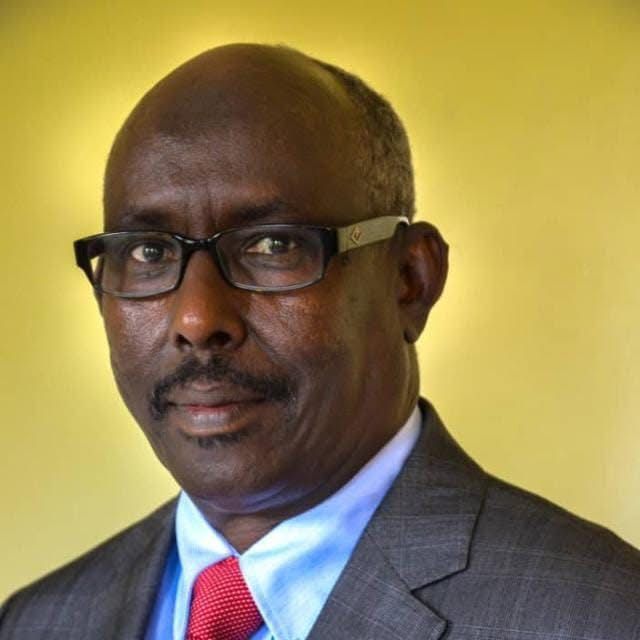
An extraordinary and, in many respects, remarkable national event took place in Mogadishu on April 25, 2026: the inauguration of a new traditional leader, Ugas Abdirizaq Ugas Abdullahi Ugas Fara-Adde of the Murusade clan.
The ceremony brought together an unprecedented gathering. Federal and regional leaders attended, including presidents; the Speakers of both Houses of the Federal Parliament; the Prime Minister and Deputy Prime Minister; ministers; former parliamentarians; a former president; former prime ministers and deputy prime ministers; leaders of the armed and security forces; civil society figures; top business leaders; and traditional elders representing the 4.5 clan structure of the Federal Republic of Somalia. Delegations from Somali communities in Ethiopia, Djibouti, and Kenya were also present, alongside a large number of distinguished guests.
Normally, such functions concerning traditional leaders fall under the competence of the Ministry of Interior, National Reconciliation, and Federal Affairs.
The event itself was dignified, well-organized, and deeply rooted in Somali tradition. It reflected honor, prestige, continuity, and the enduring relevance of traditional leadership institutions. It deserves recognition, respect, and appreciation. It was a powerful demonstration of Somali society’s ability to celebrate its heritage with unity and discipline.
Yet one legitimate and pertinent question arises:
How can such a display of unity and national cohesion coexist with the severe and escalating political crisis confronting Somalia today?
The presence of top Federal Government leaders—particularly President Hassan Sheikh Mohamud—stands in stark contrast to the political reality beyond the ceremony. While the event projected unity, legitimacy, and continuity, Somalia’s political environment is defined by division, mistrust, an unprecedented level of corruption and abuse of power, and intensifying preparations for potential violent confrontation between the Federal Government and opposition forces, including several Federal Member States and organized political groups.
Ironically, many speakers at the ceremony openly acknowledged the gravity of the political crisis. They called for renewed dialogue, national reconciliation, and a return to political consensus to prevent Somalia from sliding into disarray. These were sober and responsible appeals.
However, the President appeared more focused on dominating the moment—less attentive to the speakers’ pleas and warnings and more satisfied with the optics of the occasion: the full-court reception, applause, and the spectacle of sharing the limelight of unity and public jubilation.
The contrast was not merely symbolic—it was deeply ironic and disturbing.
On one side stands a society capable of unity, order, and respect for tradition. On the other stands a political leadership environment marked by exclusion, centralization, failed negotiations, and growing tension and despair. The gap between these two realities is widening.
More concerningly, the President increasingly conducts himself as though he is the sole entrusted holder of political legitimacy, while opposition leaders and representatives—who are among the principal holders of political accountability and representation—are treated as insignificant, noisy, peripheral, or inconvenient voices. This approach deepens contention, erodes respect, and further narrows the already shrinking space for political dialogue and the resolution of conflicting interests.
A Constitutional Crisis in Plain Sight
Somalia is now facing a clear constitutional crisis. The mandate of the Federal Parliament expired on April 14, 2026. The presidential term is set to end on May 15, 2026—less than 19 days away. These are not contested facts—they are constitutional realities.
The implication is equally clear: the Federal Government (the executive) must operate in a caretaker capacity, limited to essential administrative functions and the preparation for an orderly transfer of power and responsibilities.
What is happening, however, points in the opposite direction. Institutions whose mandates have expired—or are about to expire—continue to exercise full governing authority. Decisions are being made, processes are being controlled, and public resources are being utilized without constitutional legitimacy or authorization.
This is not continuity of governance—it is a breach of constitutional order.
Only the Council of Ministers (the Federal Government) is constitutionally permitted to function in a caretaker capacity. The Parliament and the Presidency are not.
At the same time, there is no agreed political settlement for transition. There is no consensus on the constitutional framework, no agreement on the electoral process for a new parliament, and no clarity on the process through which that parliament would elect a president and form a legitimate government. This vacuum fuels fragmentation, weakens trust, and heightens the risk of systemic collapse.
Federal Member States Under Direct Control and Manipulation
The crisis extends into key Federal Member States—particularly Southwest, Hirshabelle, and Galmudug. In the case of Southwest State, military force was used to remove the sitting regional administration. That authority was effectively displaced, and the state is now under the control of federally appointed officials. This is a fact with serious implications for federalism and the rule of law.
Equally concerning is the evolving political dynamic in which the leadership of these states is being preselected and managed directly from the presidency. This predetermination is no longer speculative—it has become an entrenched reality in the current political culture. Some citizens, regrettably, participate in nominal political organizations and electoral exercises merely as entry points into a system shaped by opportunism and compromised integrity. The Mogadishu (Benadir) local elections of December 25, 2025 stand as a clear example, having further deepened public distrust.
Current developments go even further.
There are credible and widespread concerns that the predetermined leadership of these Federal Member States will be produced through computer-generated outcomes rather than through any genuine participatory process. This is facilitated by the concentration of authority—control over the electoral commission, management of election infrastructure and information systems, and financing outside normal parliamentary oversight—all centralized within the presidency in a manner inconsistent with any recognized democratic standard.
The so-called “one person, one vote” framework has neither been accepted as legitimate and feasible nor meaningfully implemented. The structural reality of the 4.5 clan power-sharing formula, intertwined with political party structures, cannot be genuinely reconciled with President Hassan Sheikh Mohamud’s purported one-person, one-vote model. As a simple test, claims of one million registered voters contrasted with turnout figures reportedly below 100,000 have severely undermined the credibility of the Mogadishu (Benadir) elections.
What is being presented as an exemplary electoral process is, in reality, a controlled exercise with a predetermined outcome. It substitutes genuine political competition with administrative determination and the manipulation of results.
Such practices do not build democracy—they erode it. They do not strengthen legitimacy—they destroy public trust. In short, the Federal Government has, in effect, abandoned a political process grounded in constitutional principles, institutional legitimacy, and public accountability.
Against this backdrop, the April 25 inauguration stands as a striking contradiction: a society capable of demonstrating unity, dignity, discipline, and respect for established institutions, while at the same time almost passively witnessing its constitutional order and federal system—built through years of national and international effort—drift toward disarray.
The challenge now is unmistakable.
Leaders who successfully organized and executed such a remarkable national gathering—and those who participated in honoring traditional leadership—must now confront the political crisis engulfing the country with equal seriousness, responsibility, and resolve.
Symbolic unity must now be matched by constitutional legitimacy.
Without a genuine course correction—grounded in the formally agreed Constitution, inclusive political dialogue, and credible governance processes—the gap between national cohesion and current political practices of division, abuse, and mismanagement will continue to widen, ultimately undermining even the honor and stability of traditional institutions.
If that gap remains unaddressed, it will not stay symbolic—it will become a source of disorder and destruction, with lasting consequences for Somalia’s unity, sovereignty, governance, and future.
Dr:Mohamud Uluso
Former Minister and Governor of the Central Bank of Somalia; currently a political, economic, governance analyst on Somali affairs and Insidesomalia Columnist.
Email: Mohamuduluso@gmail.com

