

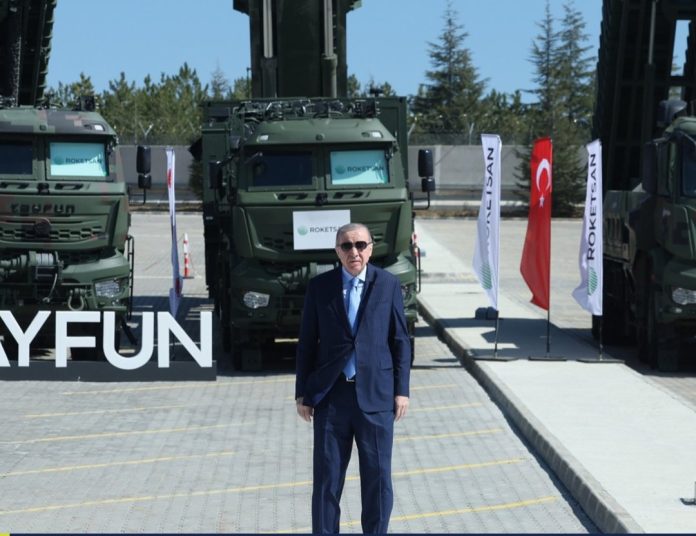
Spurred by regional threats and the goal of defence-industrial autonomy, Türkiye has and continues to develop a broad and increasingly capable missile portfolio spanning ballistic and cruise designs, transforming its guided-weapons sector in the process.
Regional missile threats and a desire for defence-industrial autonomy have motivated Ankara to build a broad portfolio of ballistic and cruise missiles. During the Cold War, Türkiye’s status as a NATO frontier state bordering the Soviet Union made it a theatre for potential ballistic-missile exchanges. Rather than pursuing indigenous missiles, Türkiye relied on NATO’s collective defence, nuclear guarantees from the United States and the deterrent value of its air power.
This posture began to shift in the late 1980s and early 1990s. The Iran–Iraq war and Iraq’s Scud strikes during the Gulf War highlighted the vulnerability of population centres and military infrastructure to missile attacks. Concerns were reinforced by neighbouring chemical- and biological-weapons programmes and missile risks, while frictions over NATO missile-defence deployments highlighted the limits of relying solely on Alliance arrangements. By the mid-1990s, Turkish planners were pursuing missile-defence options and retaliatory strike capabilities as well as a more capable defence-industrial base.
This paper maps the strategy that emerged and traces its implementation. It reviews the origins and status of Türkiye’s ballistic- and cruise-missile programmes and shows how missiles have become a key complement, and in some cases a substitute, for crewed air power. Early steps prioritised licensed local production and technology transfer, including cooperation with China and the concentration of work under Roketsan and TUBITAK SAGE.
In its ballistic-missile programme, Türkiye pursued a twin-track approach, simultaneously importing limited systems while building a national design and manufacturing base. Türkiye acceded to the Missile Technology Control Regime in 1997. It also purchased 72 MGM-140 Army Tactical Missile System missiles and leveraged them during the 1998 crisis with Syria. Development programmes eventually moved beyond the 150–300 kilometre class towards longer-range options. Political backing was sustained, including direction from President Recep Tayyip Erdoğan in 2025 to boost stocks of missiles with a range of 800 km and above and accelerate development of a missile with a range of over 2,000 km.
With regard to Türkiye’s cruise-missile programme, a land-attack effort in the early 2000s was shelved for a decade, as industrial immaturity and export controls restricted access to critical subcomponents, before being restarted in 2013. Cruise-missile growth has been enabled by domestic engine development, leading to the expansion of cruise-missile families and smaller strike options designed for multiple platforms, including launch from uncrewed platforms.
Missile use in the Russia–Ukraine war and Iran–Israel exchanges has demonstrated both the operational value of long-range precision weapons and the challenges for air and missile defence in countering them. Geographic limitations on missile testing have also shaped Turkish decisions. Türkiye is investing in a spaceport in Somalia to support space-launch vehicles and to enable long-range ballistic-missile tests. Timelines and performance remain uncertain for some advanced projects, but Türkiye’s guided-weapons sector is now nearly unrecognisable from its early twenty-first century baseline. Further ballistic, cruise and hypersonic propulsion R&D work is under way.
Source:IISSBNEWS

