

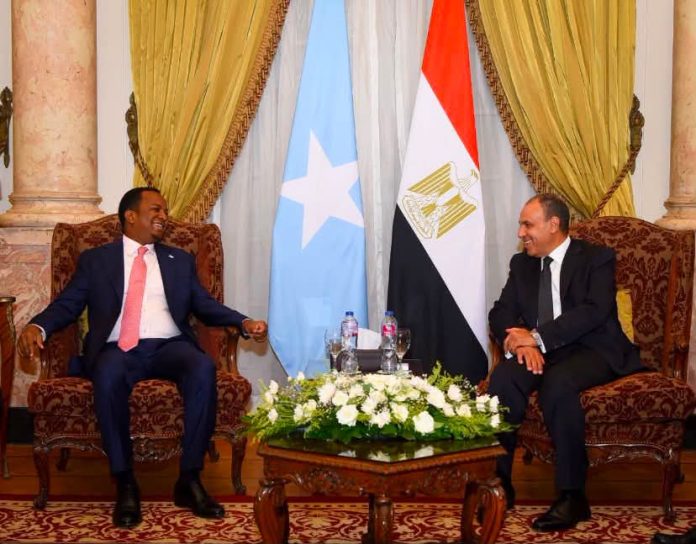
Egyptian Foreign Minister Badr Abdelatty on Sunday held separate talks with his Eritrean counterpart Osman Saleh on “enhancing the strategic partnership”, and Somali Foreign Minister Abdulsalam Abdi Ali, focusing on “strengthening bilateral relations”.
The discussions with both envoys also touched on “coordinating positions” and discussing the latest developments in the Horn of Africa, according to Egypt’s Ministry of Foreign Affairs.
The talks come as Egypt increasingly frames the “security and stability of the Horn of Africa” as “a direct extension” of its own “national security” interests. Cairo has repeatedly claimed that instability in the Horn of Africa region, particularly around the Red Sea and its maritime routes, “directly affects” Egypt’s strategic and national security.
Egypt’s latest diplomatic push also follows Eritrean President Isaias Afwerki’s 17 July meeting with Sudanese Sovereign Council Chairman Gen. Abdel Fattah al-Burhan in Asmara.
The two discussed bilateral ties, developments in Sudan, and regional and international issues. Both Cairo and Asmara have backed Gen. al-Burhan’s Sudanese Armed Forces (SAF) in the ongoing war in Sudan.
Egypt and Eritrea have also stepped up strategic coordination in recent months on Horn of Africa affairs, maritime security and Red Sea governance.
Sunday’s high-level engagement follows 10 June talks in Cairo between Abdelatty and Osman, underscoring Cairo’s growing focus on developments across the Horn and the wider Red Sea security environment.
Egypt also signed a memorandum of understanding (MoU) with Somalia last week aimed at strengthening cooperation in maritime transport and ports. The move came weeks after Cairo signed a maritime transport and Red Sea port connectivity agreement with Eritrea.
Egypt, Eritrea and Somalia have each endorsed the position that “the security and management of the Red Sea remain the exclusive responsibility of its littoral states,” reflecting a broader emphasis on the role of Red Sea coastal countries in determining the strategic future of the waterway.
The intensifying regional alignment has drawn scrutiny from Ethiopia. In May, Ethiopia’s Ministry of Foreign Affairs accused Egypt of pursuing an “encirclement” strategy and intensifying efforts to undermine Ethiopia after Addis Abeba elevated sovereign sea access as a “national interest.”
Prime Minister Abiy Ahmed has maintained that his government will continue pursuing maritime access through “peaceful and diplomatic” means.

