

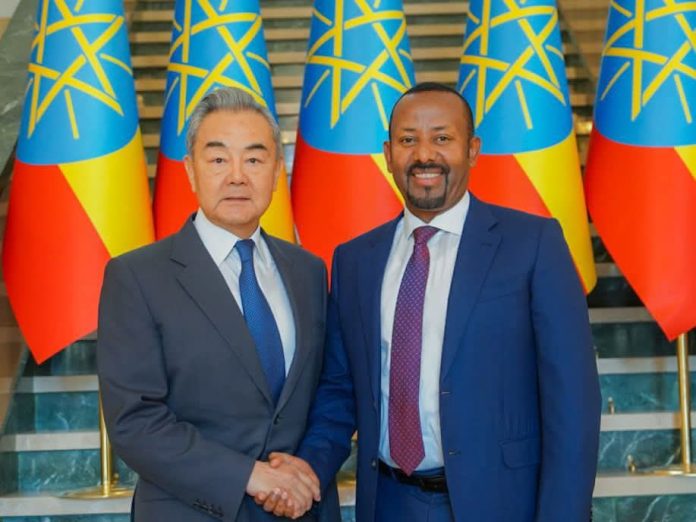
Prime Minister Abiy Ahmed today received China’s Minister of Foreign Affairs, Wang Yi, at the National Palace, on the occasion of the Chinese foreign minister’s two-day official visit to Ethiopia.
According to the Office of the Prime Minister, the meeting focused on #Ethiopia–China bilateral relations as well as regional and international issues of mutual interest.
Wang Yi’s visit to Ethiopia is part of a broader weeklong tour of African countries, which also includes Somalia, Tanzania, and Lesotho, running from January 7 to 12, according to a statement from China’s Ministry of Foreign Affairs.
During his stay in Addis Abeba, the Chinese foreign minister is also expected to attend the launching ceremony of the China–Africa “Year of People-to-People Exchanges” at the headquarters of the African Union (AU).
The visit marks the 36th consecutive year in which Africa has been the destination of China’s foreign minister’s first overseas trip of the year, underscoring Beijing’s longstanding diplomatic focus on the continent.
Wang’s visit to Somalia marks the first by a Chinese foreign minister since the 1980s and comes at a sensitive time for the Horn of Africa nation. Beijing has expressed support for Somalia following Israel’s recognition of the breakaway Somaliland region in December 2025.
Somali officials welcomed the visit as a diplomatic boost amid ongoing security and governance challenges, particularly around the Gulf of Aden—a vital corridor for Chinese trade passing through the Red Sea to Europe.
China remains Africa’s largest trade partner, with bilateral trade reaching $296 billion in 2024. The ministry highlighted that the tour aims to “inject fresh impetus into the building of an all-weather China-Africa community with a shared future,” with Ethiopia and Somalia serving as key hubs for advancing political, economic, and cultural cooperation.
Observers note that Wang’s visits are part of a 36-year tradition of beginning the year in Africa, signaling Beijing’s enduring focus on the continent despite global uncertainties. In the Horn of Africa, China’s engagement continues to balance strategic interests, trade access, and diplomatic influence, particularly as regional dynamics shift with growing involvement from other global actors.

