

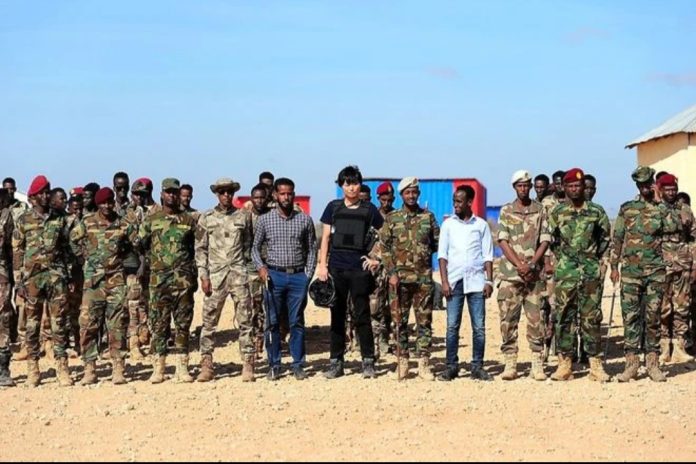
Working on the front lines of a conflict zone in Somalia, Yosuke Nagai, clad in a helmet and a bulletproof vest, travels in an armored car with a military escort for safety.
Nagai, founder and executive director of the nonprofit Accept International, operates a deradicalization program that helps former terrorist group and gang members return to society.
As expected, his mission carries enormous safety risks in Somalia where there are frequent outbreaks of violence. In the country, terrorist threats are common, and Nagai lost a colleague in a suicide attack.
Every time he prepares for a trip to a combat zone, Nagai, 34, updates his will and handover notes to his potential successor that he leaves in a USB flash drive.
His group’s deradicalization program features a series of intensive dialogues with returning fighters of extremist groups and gang members.
“We believe that accepting them as individuals with potential, rather than risks and threats to society, will lead to a solution,” Nagai said. “Our approach is to make the community function better with returnees.”
BECOMING ‘AGENTS OF PEACE’
The organization’s inclusive-based program urges them to share their thoughts on their current situation and review their way of thinking.
The individuals are given a basic education, a religious education designed to steer them from radicalism, counseling and engage in a round of discussions with community leaders.
In addition, Accept International makes painstaking preparations for participants to gain practical work-related skills in areas such as carpentry, cooking and driving, based on the recognition of their harsh environment.
This outreach is aimed at enabling them to become “the agents of peace” in their communities.
Nagai and his colleagues also regularly visit prisons and rehabilitation facilities to listen to the stories and the thoughts of inmates, defectors from extremist groups and prisoners of war.
Accept International, based in Tokyo, offers similar programs in Kenya, Yemen, Palestine, Indonesia and Colombia. In Japan, it is involved in a project that brings in former inmates of juvenile detention centers or prisons for counseling delinquents.

