

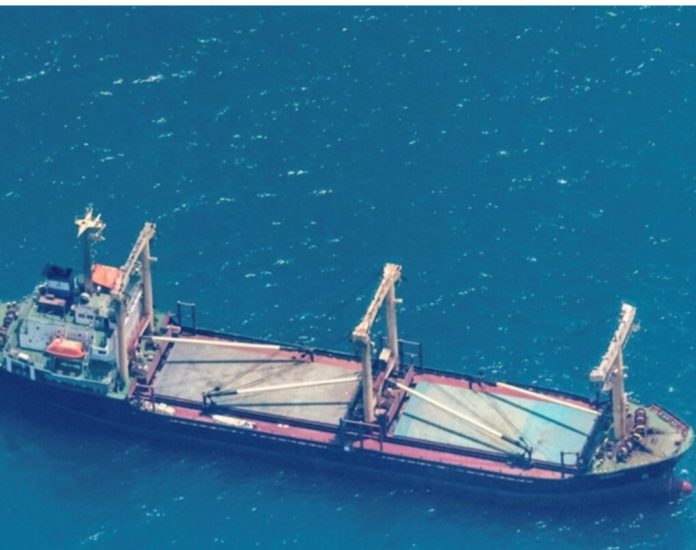
Three ships were hijacked in just 1 week off the coast of Somalia, raising concerns about a sea piracy outbreak in the Horn of Africa.
The cargo ship Sward was hijacked on April 26, just 1 day after a dhow (traditional Arab sailboat) was hijacked.
Previously, on April 21, the Honour 25 oil tanker carrying 18,000 barrels of oil was also controlled by pirates, according to the Indian Ocean Maritime Security Center (MSCIO) – a monitoring agency of the European Union (EU) navy.
In a statement earlier this week, MSCIO said: “All incidents are still ongoing… Ships operating in the area are advised to maintain high alert… especially within 150 nautical miles from the Somali coast, the section between Mogadishu and Hafun when possible.
Sward is a cement ship leaving the Egyptian port of Suez on April 13. The ship was en route to Mombasa, Kenya when it was controlled by pirates about 6 nautical miles from the Somali port city of Garacad. According to 3 security officials of the Puntland region – an autonomous region of Somalia, the ship has 17 crew members, including 15 Syrians and 2 Indians.
After the attack, at 8 pm on April 26, the pirate group drove the ship close to shore and anchored in a remote area near Garacad. Six gunmen and 1 unarmed interpreter, fluent in English and Arabic, then boarded the ship
This person is not only talking to the crew but also working with the ship owner,” a security official said. Another official said: “The interpreter is the ringleader.
By the morning of April 28, 4 more gunmen boarded the Sward, bringing the total number of pirates on board to 20 people.
Mr. Jethro Norman – senior researcher at the Danish Institute for International Studies – said that pirates have taken advantage of the international navy’s transfer of resources to the Red Sea to deal with Houthi attacks, while the Puntland security forces backed by the United Arab Emirates are also overloaded.
Pirate networks are trying to return and they are better equipped than the previous generation. GPS, satellite communication and takedown boats of the dhow help them operate hundreds of kilometers from the shore,” Norman said.
Another Puntland security official informed on April 28 that a batch of khat – a addictive stimulant commonly used in the Horn of Africa region – was transported by a small boat to supply the robbery group on a cement ship.
This shipment was transported about 241km from the city of Galkayo on April 27, showing that pirates have a support network on land and may be preparing for a long-term sea ambush.
Piracy around Somalia increased sharply in the late 2000s and peaked in 2011 with 212 attacks, according to data from the EU navy. At that time, pirates became increasingly reckless, attacking ships 3,653km off the coast of Somalia in the Indian Ocean.
After that, an international naval alliance curbed the wave of piracy attacks, helping the number of piracy cases decrease to only a few cases per year from 2014. However, attacks began to increase again from 2023.
The global shipping industry has already been heavily affected by the almost completely blockaded Ormuz Strait and the attacks by Houthi forces in Yemen taking place around the Bab el Mandeb Strait. Ships have to go through these straits to leave the Red Sea and many ships then continue their journey around the Horn of Africa.
Sources:Loadong.

