

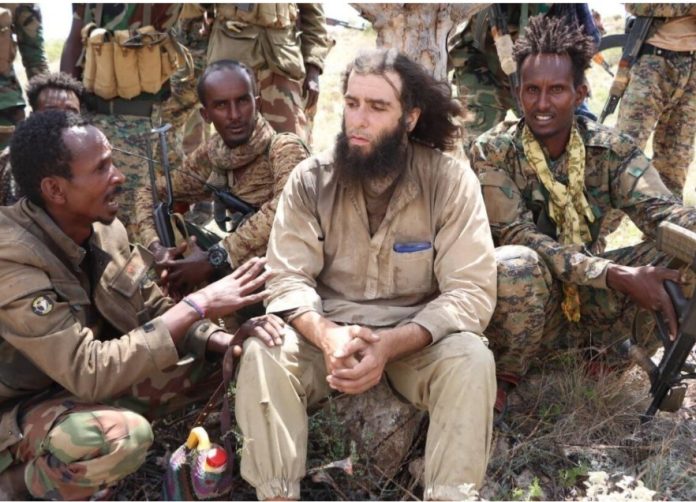
A Turkish national who was expelled from the Netherlands after being convicted of preparing a terrorist attack was able to reconnect with the jihadist ecosystem after settling in Turkey and ultimately make his way to Somalia, where he joined the local branch of the Islamic State in Iraq and Syria (ISIS) and was captured carrying an assault rifle.
The case of Hasan Rafet Atar, a Dutch-born man of Turkish origin, offers a striking example of how militants with well-documented extremist histories have been able to re-enter transnational jihadist networks from Turkish territory despite Ankara’s stated commitment to crack down on ISIS and repeated public claims that it has dismantled ISIS recruitment, financing and logistical structures.
The documentary record shows that Atar was well known by Turkish authorities when the Netherlands deported him to Turkey on May 3, 2022. Dutch authorities had stripped him of his citizenship after he was convicted of preparing a terrorist attack, gathering information on potential targets and studying firearms and knife attacks while immersed in ISIS propaganda. The Netherlands considered him a serious threat to public order and national security and imposed a 20-year entry ban.
Yet within roughly two-and-a-half years of his arrival in Turkey, Atar was again inside the ISIS network, this time thousands of kilometers away in Somalia’s Puntland region.
His trajectory is especially troubling because later Dutch court records indicate that when he arrived in Turkey, Turkish authorities questioned him but did not take any action and failed to monitor him. In litigation challenging his deportation, Atar submitted a statement claiming Turkish officials who questioned him upon arrival were unaware that he had been removed after a terrorism conviction.
Yet a Turkish police counterterrorism report, covered partially in the local media in Turkey, put him on a list of names associated with ISIS and even recorded his alleged travel to Syria.
According to Atar’s subsequent account from prison in Puntland, revealed in an interview he gave to The Times British daily, after settling in Turkey he worked at a textile factory but gradually returned to consuming ISIS propaganda. He said he found an email address in an ISIS video and began corresponding with a recruiter he knew as Abu Khalid.
The recruiter told him that ISIS was rebuilding in Puntland and urged him to travel to Somalia, promising money, accommodation, marriage, medical care, friends and a new family. Atar said he was depressed and angry while living in Turkey and accepted the offer because he believed the organization would take care of him.
In other words, by his own account, a convicted jihadist who had been expelled from Europe to Turkey was able to establish direct contact with an ISIS recruiter while living on Turkish soil and arrange his entry into another of the terrorist organization’s overseas branches.
Atar reached Somalia in the autumn of 2024, according to his account. Once there, ISIS members confiscated his telephone, watch, passport and approximately $800. Instead of receiving the comfortable home he claimed had been promised, he found himself living with a large number of militants in caves in the Cal Miskaad mountains of Puntland.
He later claimed that he asked to leave the organization and return to Turkey but was refused.
His military training was interrupted in December 2024 when Puntland forces launched a major offensive against ISIS positions. Because he lacked sufficient battlefield experience, he was assigned to a roughly 10-man logistics unit tasked with supplying militants fighting on the front. Puntland intelligence subsequently confirmed his logistics role.
Puntland forces captured Atar in the mountainous Bari region while he was alone collecting water from a well. Brig. Gen. Ahmed Abdullahi Sheikh, one of the senior commanders overseeing the counterterrorism campaign, said Atar was carrying an AK-47 when soldiers from the Puntland Defense Forces’ 3rd Battalion took him into custody.
By December 2025 Atar was still imprisoned in Puntland awaiting trial and could face the death penalty if convicted.
Atar’s later portrayal of himself as a vulnerable man manipulated by extremists after being sent to prison is difficult to reconcile with the official Dutch record.
The Hague Court of Appeals established that his terrorist activity took place between October 1, 2014, and August 19, 2016, before the imprisonment during which he later claimed other inmates radicalized him.
Source:nordicmonitor.com

