

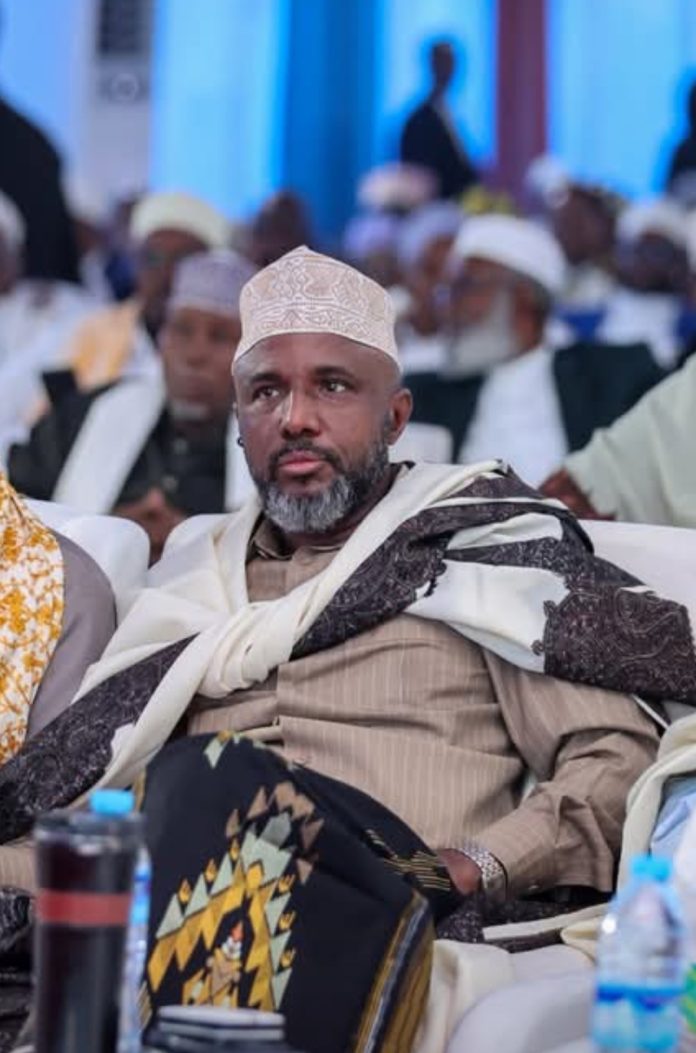
President Hassan Sheikh Mohamud convened a dinner meeting at Villa Somalia with prominent traditional leaders who had attended the inauguration of Ugas Abdirizaq Ugas Abdullahi Ugas Fara-Adde. The meeting followed alarmed statements by traditional elders, civil society, and political actors over a deepening political crisis threatening Somalia’s unity, constitutional order, and stability. These concerns have intensified sharply following the expiration of the Federal Parliament’s mandate, with the President’s own term set to end on May 15, 2026—less than three weeks away.
During the meeting, the traditional leaders spoke candidly and firmly. They urged the President to reverse the current political direction and engage the opposition in genuine dialogue to reach consensus on three urgent matters: the constitutional framework, the electoral model required to restore legitimacy, and the establishment of credible structures and procedures capable of delivering transparent and peaceful elections within a very limited timeframe. They stressed that, given Somalia’s fragility and dependence on international support, consensus is not optional—it is essential.
However, instead of directly addressing these recommendations, President Hassan delivered a 16-minute speech that was disappointing, contradictory, confusing, and dismissive. Rather than engaging with the substance of the concerns, he downplayed the severity of the crisis and, in doing so, appeared to impugn the judgment and standing of the traditional leaders.
From the outset, the President minimized the gravity of the situation. He did not meaningfully respond to the call for urgent corrective action but instead reverted to three familiar talking points.
First, he reiterated his “red line”: rejecting any continuation of the indirect electoral system, which he falsely linked to insecurity. He reaffirmed his commitment to his pseudo one-person, one-vote model based on political parties, yet still anchored in clan-based power-sharing and to a so-called “completed constitution” owned by his administration.
Second, he repeated that Somalis should not fear the transition to universal suffrage, presenting it as inevitable and beneficial without addressing the serious legal, institutional, and security constraints raised by critics and independent experts.
Third, he maintained that the door to dialogue remains open—despite repeated failures of past consultations to produce meaningful consensus. In reality, such dialogue appears conditional: acceptable outcomes must align with the federal government’s predetermined direction.
This position exposes a fundamental contradiction. While claiming openness to negotiation, the President insists on proceeding with his predefined, controversial agenda without pause, adjustment, or compromise. At times, he invites debate on political parties and electoral models; at other times, he insists on continuing unilaterally. He considers the opposition as jobless actors with no invested authority. The implication is clear: any new negotiations would merely reset the process, prolonging the transition and extending his tenure.
This contradiction deepens further in the ongoing pseudo one-person, one-vote process itself, which is widely criticized as opaque, centrally controlled, and manipulated. The President appears to be shaping both the process and its outcomes. This is not speculation—it is grounded in publicly available evidence. Claims of transparency and fairness are therefore irreconcilable with observable realities.
In his speech, the President also referenced unrelated issues—debt relief, the Ethiopia–Somaliland memorandum, the lifting of the arms embargo, the Kenya–Somalia maritime dispute, oil and gas exploration, and the Turkish government. These references appeared intended to discredit the opposition, divert attention from the immediate crisis, and portray his administration as effective and farsighted.
Yet these claims omit critical context. Somalia’s debt was forgiven in 1996. The only requirement was to undergo a debt relief program that included macroeconomic reforms, public financial management reforms, good governance and transparency measures, and the implementation of a poverty reduction strategy, along with a commitment to repay residual debt obligations. Somalia therefore still carries debt in the billions, far beyond its sustainable capacity, especially since its domestic revenue remains below $450 million annually—barely sufficient to cover employee compensation. Around 70% of the $1.331 billion national budget is financed by international donors. Key milestones, such as debt relief and the lifting of the arms embargo, were largely donor-driven efforts to strengthen Somalia’s sovereign capacity. However, the government has failed to translate these opportunities into durable institutional gains, raising serious concerns about the sustainability of state-building.
A recurring rhetorical pattern in the President’s speech is the use of “but”—acknowledging concerns only to immediately dismiss or dilute them. This reflects a broader tactic of appearing responsive while maintaining an unchanged position.
Particularly troubling was his reference to Somalia’s 1969 election as a model. That period is widely associated not with democratic success, but with electoral manipulation, political breakdown, and the collapse of civilian governance, leading to military rule. The comparison ignores these lessons. A one-person, one-vote system does not guarantee credibility, stability, or benefits without strict adherence to rules, independent oversight, and accountability.
Similarly, claims that the proposed model empowers citizens are difficult to reconcile with continued clan-based power-sharing. Comparisons with Puntland and Somaliland are misleading, given their different electoral designs, institutional capacities, and levels of public trust. The claim that the December 2025 Mogadishu election was peaceful is equally questionable, given the citywide lockdown, low turnout—fewer than 80,000 voters—and widespread boycott. Notably, the results have yet to produce functioning local governance structures.
Another inconsistency lies in the President’s broader narrative. While suggesting the economy is performing adequately, he acknowledged that the political system remains in trouble and outlined the need for a political settlement, credible institutions, and adherence to the Constitution. Yet he simultaneously downplayed the urgency of political reconciliation and consensus, arguing that the current political tensions are cyclical and self-resolving—a view that trivializes a structural crisis requiring immediate action.
The overall impression is that, while the President engaged the traditional leaders in form—hosting them and listening—he remains firmly committed to his widely rejected course. The meeting may also have served to manage perceptions, influence positions, divide opinion among the elders, and shift focus away from the core crisis.
In conclusion, the President’s message was unmistakable: he intends to remain in power and proceed with his controversial and opposed agenda. His invocation of a five-year term—contrary to the recognized four-year constitutional mandate—is a pre-planned, constructed justification for extended authority. This narrative, first advanced by the Speaker and echoed by the caretaker Prime Minister, is now being used to manufacture a constitutional dispute in the absence of legitimate institutions to resolve it.
The ultimate goal is the normalization of extra-constitutional governance.
President Hassan’s address reinforces the perception that he intends to impose a “completed constitution,” a centrally managed and widely disputed pseudo one-person, one-vote election system, and his continued leadership without renewed legitimacy.
The message from the traditional leaders was clear and urgent. It was not answered—it was dismissed. Such presidential intransigence risks the very survival of the Federal Republic of Somalia.
Dr. Mohamud M. Uluso.
Insidesomalia Columnist.

