

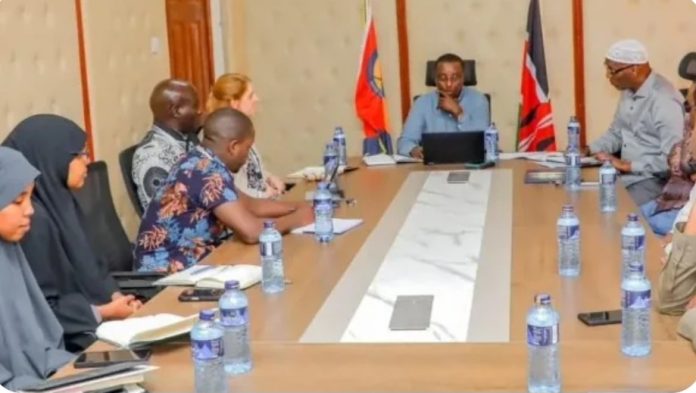
The Garissa County Assembly and the United Nations High Commissioner for Refugees (UNHCR) have started discussions on forming a formal partnership aimed at strengthening refugee governance, improving legislative oversight and supporting development programmes that benefit both refugees and host communities.
The talks took place during a meeting at the County Assembly in Garissa, where a UNHCR delegation led by Deputy Country Representative Robin Ellis held discussions with Assembly leaders led by Speaker Abdi Idle Gure.
The delegation also included the Head of the UNHCR Dadaab Sub-Office, Henok Ochalla, and UNHCR official Charles Odera.
The discussions focused on creating a structured framework for cooperation between the County Assembly and UNHCR to strengthen the Assembly’s role in lawmaking, oversight and policy support on issues affecting refugees and the communities hosting them.
The proposed partnership is also expected to support the implementation of programmes designed to improve the lives of people living in Garissa County.
Speaker Gure said the County Assembly was ready to work closely with UNHCR through a formal arrangement that would allow the two institutions to maintain regular engagement on issues affecting the county. He said such cooperation would also strengthen accountability and improve the implementation of projects supported by both parties.
“We would wish to establish a structured partnership with UNHCR that culminates in sustained engagement on matters of mutual interest and shared development goals,” Gure said.
The Speaker noted that the Assembly’s constitutional role in legislation, oversight and budget approval placed it in a position to support programmes linked to refugee management and community development.
He also outlined several areas where the Assembly hopes to work with UNHCR, including promoting civic participation through the Ward Youth Champions Programme, supporting the implementation of the Refugees Act at the county level, strengthening the capacity of the Assembly Secretariat and promoting efforts to prevent and resolve conflicts that may arise as refugees and host communities live together under the Shirika Plan.
Source: Eastleigh voice

