

The Federal Government of Somalia (FGS) revealed its authoritarian character on May 10, 2026, when it used abusive and unlawful tactics to suppress a peaceful public demonstration organized in solidarity with poor and vulnerable families who had been forcibly evicted from land they had lived on for more than 36 years. Their homes were destroyed, their livelihoods shattered, and the land was reportedly sold to speculators through corrupt and unlawful arrangements.
For this reason, the opposition declared May 10 a day of solidarity with the victims of land confiscation and public resource plunder. The demands were straightforward: stop further evictions, return unlawfully seized land, investigate the sale of public land, and account for the revenues collected from those sales.
I will address the broader issue of land confiscation, forced evictions, and corrupt land sales in a separate article. Here, I focus on the federal government’s suppression of the constitutional right of Mogadishu residents to demonstrate and protest peacefully.
Article 20 of the Provisional Constitution guarantees the right to peaceful assembly and demonstration without prior government authorization. This right cannot be restricted through arbitrary, politically motivated, or abusive measures.
Yet, on the night before the protest, the Federal Government surrounded the homes of opposition leaders, blocked roads leading to their residences, deployed masked security forces armed with automatic weapons across Mogadishu, and severely restricted public movement throughout the city. The response to this repression could easily have escalated into armed confrontation, but the opposition exercised restraint and avoided violence.
Even more alarming was the reported disruption of the EVC mobile payment system, the primary payment method used in Somalia. The disruption caused panic among businesses and ordinary citizens and prevented many people from participating in the demonstrations because they could not use Bajaj transport or pay fares. This was an unprecedented and dangerous method of suppressing public protest. The public deserves a clear explanation.
The government ordered demonstrators to gather only at a stadium in northern Mogadishu, ignoring the distance, transport difficulties, roadblocks, intimidation, and payment disruption imposed on the public. Former President Sheikh Sharif Ahmed stated that security forces even denied access to the stadium and brutally beat some of those who managed to enter.
Security forces reportedly killed one demonstrator and wounded many others during protests in different parts of Mogadishu.
The government’s handling of the demonstrations reflected the familiar tools of authoritarian rule: deception, intimidation, false accusations, excessive force, abuse of state power, and violence. Somalia rose up against such practices 36 years ago, yet they are reappearing under the current administration. President Hassan Sheikh Mohamud has shown little commitment to the democratic principles of the Provisional Constitution. Instead, his conduct increasingly resembles that of leaders who use state institutions to dominate society and prolong their hold on power.
To date, the Federal Government has shown no remorse and offered no apology for the killings, injuries, beatings, and intimidation directed at peaceful demonstrators. The constitutional rights of citizens were openly violated. Many Somalis are shocked by the government’s lack of restraint and are demanding an independent investigation and accountability.
The government itself no longer enjoys full constitutional legitimacy. The mandate of the Federal Parliament expired on April 14, 2026, and the President’s term expires on May 15, 2026, only days after this assault on public freedoms. An administration operating under such circumstances should act with restraint, not repression.
On May 10, President Hassan addressed the public on two issues: the disputed elections in Southwest State and the demonstrations in Mogadishu.
After the widely criticized so-called one-person, one-vote election experiment in Benadir Region, the federal government launched another controversial electoral process in Southwest State after removing the previous regional administration by force. President Hassan praised the process as a democratic milestone, yet no transparent candidate lists or meaningful election details were publicly provided.
The outcome appears predetermined: a federally managed distribution of local council seats and state parliamentary positions that will eventually produce a president aligned with the Justice and Solidarity Party. Many critics believe the entire process has been politically engineered to strengthen President Hassan’s political project through a party structure designed to dominate future elections.
Critics further argue that the broader one-person, one-vote, 4.5 clan-based party model is not intended to build democracy, but rather to create a political framework for centralized control under the so-called “completed constitution.”
On the issue of the May 10 protests, the President again delivered confusing and misleading arguments. He questioned why the opposition chose to protest on the same day as the Southwest election and the dialogue meeting he had proposed. Yet the reasons were already clear to him. The questions appeared more rhetorical and political than genuine.
The opposition had welcomed dialogue, but under two reasonable conditions based on the repeated failure of past talks. First, because the planned discussions concerned the 2026 federal election model and the disputed status of Southwest, Galmudug, and Hirshabelle, the opposition requested suspension of the ongoing electoral process in Southwest State. Second, it requested the presence of international mediators or facilitators because previous negotiations with President Hassan’s administration had repeatedly collapsed. Since neither issue was resolved, the proposed date for dialogue became meaningless.
President Hassan also repeated the claim that citizens have the right to protest, but that the government must tightly control demonstrations for security reasons. In practice, this treats citizens as potential criminals before they even gather peacefully. According to this logic, demonstrations are acceptable only if they are authorized by the government and held in areas monitored and controlled by the government itself.
That is not constitutional freedom of protest. It is authoritarian control presented as public security.
The President further argued that no one may carry arms. However, Somalia’s political and security realities have long required prominent public figures, including opposition leaders, to maintain protective security arrangements. More importantly, constitutional rights cannot be suspended based on hypothetical accusations before any crime occurs. Crimes must be proven, not presumed. The government has a duty to maintain security, but that duty cannot be used to erase constitutional freedoms.
President Hassan’s statements today sharply contradict the positions he defended when he was in opposition against former President Mohamed Abdullahi Farmaajo. The gap between his past rhetoric and current actions is difficult to comprehend and impossible to ignore. Such leadership has deeply damaged public trust and weakened confidence in the Somali state.
President Hassan appears determined to prevent demonstrations against his government while simultaneously claiming to defend the right to protest. In practice, citizens are permitted to demonstrate only when they support or praise the government. That is not democracy. It is political hypocrisy.
The decision to surround opposition leaders’ homes with armored vehicles and masked security forces was not only unlawful but deeply provocative. It endangered lives and denied citizens their constitutional rights. President Hassan must answer for these actions.
Another disturbing incident was the inflammatory and threatening statement issued by the police spokesperson. The remarks crossed constitutional and legal boundaries and reflected a dangerous disregard for the rule of law. The statement exposed a growing culture of abuse of power, lack of accountability, and impunity within security institutions.
As a result, opposition figures and ordinary citizens increasingly face the risk of intimidation, injury, or even death simply for exercising their constitutional right to protest. The public cannot remain silent in the face of such danger.
May 10, 2026, will be remembered as a dark day for the freedom of protest in Somalia—a day when a government that claims democratic legitimacy exposed itself as fearful, repressive, and intolerant of dissent.
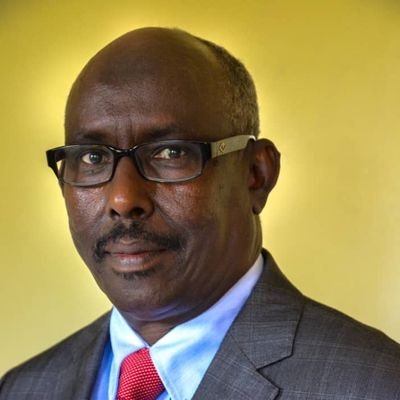
Dr. Mohamud Uluso, insidesomalia Columnist.

